
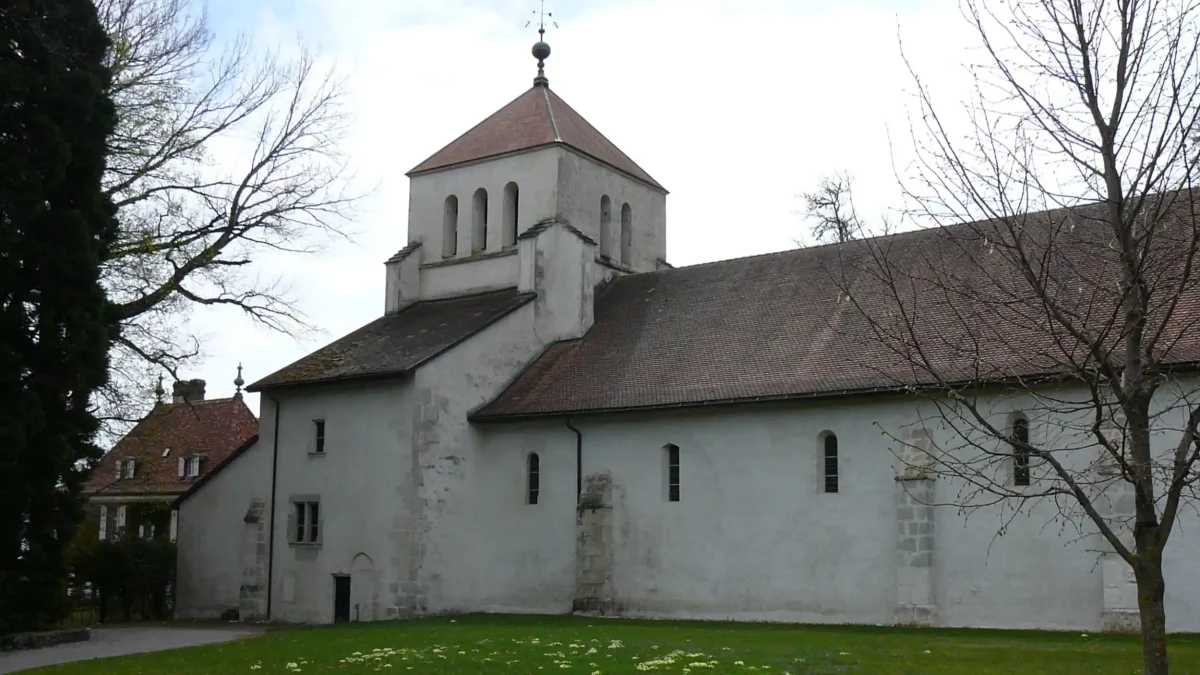
Built in the 11th and 12th centuries by the monks of Cluny, the Romanesque church of Saint-Sulpice retains a three-apse transept crowned by a central bell tower. Here you can discover Cluniac Romanesque art on the shores of Lake Geneva, near Lausanne.
Religious buildings
Romanesque Church of Saint-Sulpice
Main highlights
- Cluniac architecture from the 11th and 12th centuries, with a preserved three-apse transept
- Central bell tower rising above the transept crossing, with a sober style and clean lines
- Cultural property of national significance, shaped by the Reformation and the demolition of its nave
Overview
The church was built in two phases by the monks of Cluny between the 11th and 12th centuries. Attached to a monastery, it was first dedicated to Saint Sulpice, who gave his name to the village, and later placed under the patronage of Mary Magdalene. It comprised a nave and a three-apse transept topped by a bell tower.
In the 14th century, the priory came under the authority of the bishops of Lausanne. In 1536, with the Bernese occupation of the Pays de Vaud, the church became Protestant and passed to the city of Lausanne. The nave, too large for the congregation, was used as a barn before being demolished in 1748.
"*" indicates required fields
What to see and do
The three-apse transept is the building’s main feature. Its three semicircular apses follow a layout typical of Cluniac Romanesque art and recall the monastery’s former importance. Their arrangement can be clearly read from both inside and outside.
The bell tower rises above the transept crossing. Its sober style illustrates the Cluniac aesthetic, based on purity of line and the absence of superfluous ornament. Together, they form a clear example of medieval religious architecture in the Vaud region.
A visit also offers insight into medieval monastic organisation and the influence of the Cluniac order in the region. The missing nave, demolished in the 18th century, tells the story of the religious and political changes that followed the Reformation.
Practical information
Getting there : the site can be reached by car or public transport from Lausanne.
Visitors : the church is wheelchair accessible and free to explore on your own.
On site : the church also hosts services, concerts and private ceremonies, during which visits are not possible.
Visiting tips
Take time to observe the three apses and the bell tower from different angles, inside and then around the building. A self-guided visit also lets you appreciate the acoustics of the transept. Check ahead before coming to avoid service or ceremony times.
Nearby attractions
- The Roman Museum of Lausanne-Vidy houses the remains of a wealthy ancient residence in Lousonna and its archaeological finds.
- Morges Castle, a 13th-century Savoyard square castle on the shores of Lake Geneva, houses museums of military history and art.
- Lausanne Cathedral has overlooked the old town for more than 750 years, combining medieval architecture and spiritual heritage.
 Report an error or complete the informations
Reviews about this place